About RizzitGO Spreadsheet Fiber Content and its method
An independent site, not run by RizzitGO, that reads the cloth on clothing listings. This page covers who writes it, how the readings are made and sourced, and what RizzitGO itself publishes about the company and its terms.
An independent fiber guide, and how to reach it
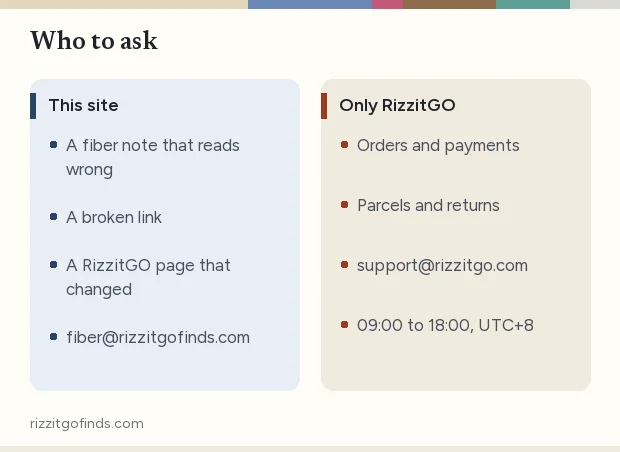
RizzitGO Spreadsheet Fiber Content is an independent site, not run by RizzitGO. It reads one thing, the cloth, on clothing found in a product catalog and bought through RizzitGO. RizzitGO does not review, approve or pay for these pages, and we have no access to its systems beyond what any visitor sees.
Links to RizzitGO and catalog shelves include referral parameters. They identify this guide as the source of a visit; this site does not claim access to your agent account or order history.
To get in touch about a fiber note that reads wrong, a link that broke or a RizzitGO page that changed, write to [email protected]. For orders, payments and parcels, only RizzitGO can help: its Contact Us page lists [email protected], and its chat panel gives service hours of 09:00 to 18:00 at UTC+8. Its own community server is on Discord.
Method behind the fiber readings
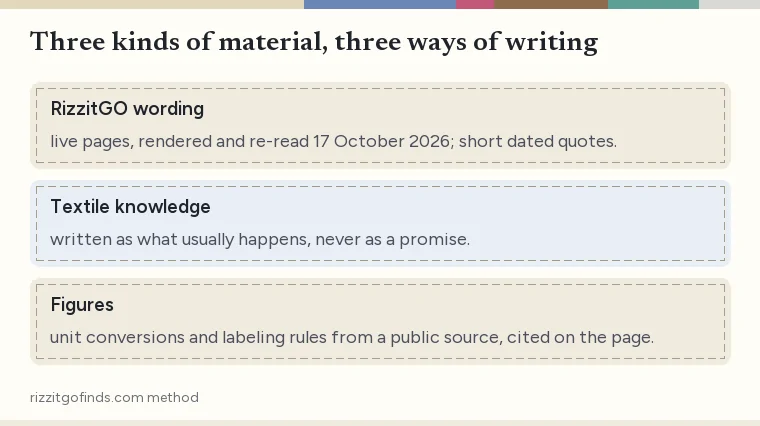
Every page here is built from three kinds of material, and each is labeled the same way throughout. RizzitGO’s own wording comes from its live pages, rendered in a browser without signing in and re-read on 17 October 2026; quotes are kept short and dated. Fiber behavior, such as how cotton shrinks or why acrylic pills, is general textile knowledge, and it is always written as what usually happens, never as a promise about a listing. Numbers that need a source, such as unit conversions and US labeling rules, cite a public one.
Some things we tried could not be done, and the pages say so where it matters: Taobao and 1688 listing searches did not load without signing in, and RizzitGO’s search showed nothing until signed in. So the descriptions of where a composition sits on a listing are what those platforms usually show, not a capture from that day.
What the readings never do: score a garment, rate a seller, compare one fiber as better than another in general, convert sizes, or tell you whether to buy. The Fiber reader follows the same rules; its card has four parts and no verdict. Nor does this site cover shipping cost, routes or customs: those depend on the parcel and the destination, not on the cloth.
Public sources behind the textile figures
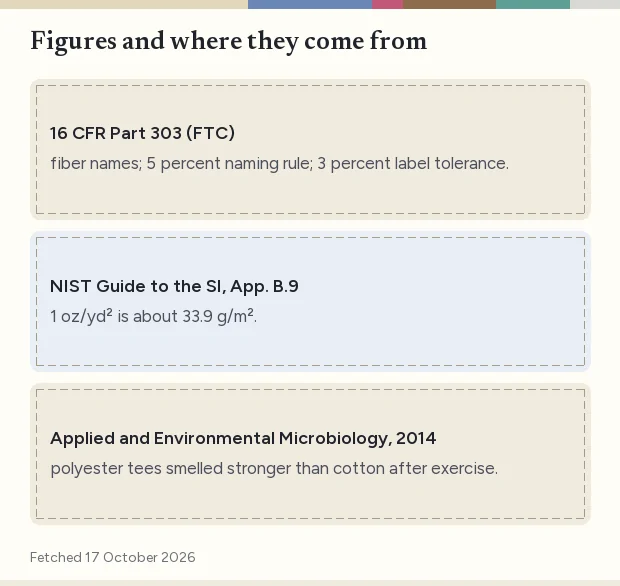
Three public documents carry the figures that are not general knowledge. The FTC’s rules under the Textile Fiber Products Identification Act, 16 CFR Part 303, define the generic fiber names used on US labels, including spandex and polyester. They require fibers at 5 percent or more to be named, let smaller ones be grouped as “other fiber” unless they have a clear function. The US rule’s 3-percentage-point tolerance applies to products containing more than one fiber, not a claim that a product is wholly one fiber. It is not a general tolerance for Chinese listings or an authenticity test. Read the specific scope in §303.43 (checked 18 October 2026).
NIST’s Guide to the SI, Appendix B.9 gives the factor behind the denim conversion, 3.390575 × 10⁻² kilograms per square meter for one ounce per square yard. And the odor comparison on the synthetics page comes from a 2014 study in Applied and Environmental Microbiology, Microbial Odor Profile of Polyester and Cotton Clothes after a Fitness Session, which tested T-shirts from 26 people after a spinning session.
Chinese fabric names and listing field names are working vocabulary rather than cited figures. Copies of the three documents as read are kept with this site’s records.
Company details and the law clause in RizzitGO’s terms
RizzitGO’s Contact Us page, updated on 28 August 2026, names WHALE VENTURE TRADING CO., LIMITED, a UK private company with the number 16832979, and the UK Companies House register showed it as active when we checked on 17 October 2026. In the app stores the publisher name shown is Hong Kong Whale Venture Trading Co., Limited. We note both names as published and draw no conclusion about how they relate.
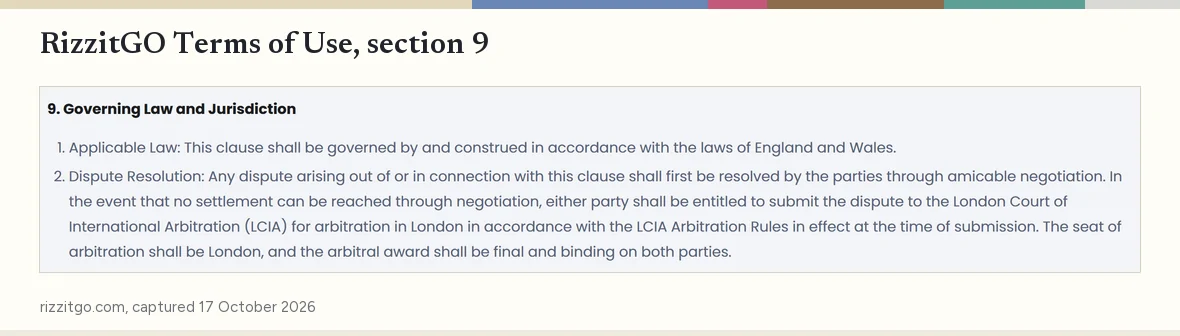
RizzitGO’s Terms of Use, last updated on 25 November 2025, choose the laws of England and Wales in section 9, with disputes going first to negotiation and then to arbitration at the London Court of International Arbitration. The clause is shown below as rendered. Separate parcel-shipping terms refer to PRC law and Hong Kong courts. These documents do not give one consistent dispute clause; ask the agent which terms govern the service you are buying.
RizzitGO’s Anti-Counterfeiting Policy prohibits non-authentic goods and sets out what it does about them. In its own words: “Violations may result in loss of service access, withheld funds, destruction of inventory in fulfillment centers, and other legal consequences.”
This site keeps to the same line. It reads cloth, says nothing about where a piece is copied from, and does not point readers to any source of non-authentic goods. RizzitGO’s policy page has the full text.
None of this is legal advice, and we do not summarize the rest of RizzitGO’s terms. Read them on RizzitGO before a large order; the live version is the one that applies.
RizzitGO’s pages carry other company names in older template documents as well. We only repeat the name and number from its Contact Us page, which RizzitGO keeps current.
What makes a useful spreadsheet for clothing
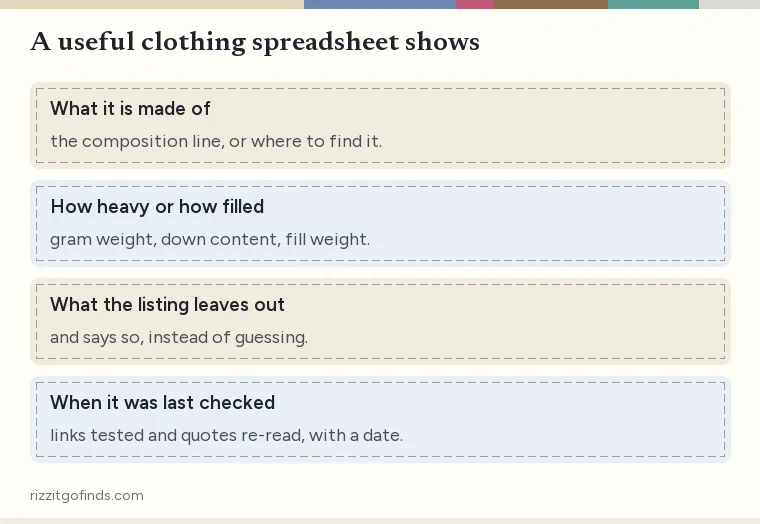
A spreadsheet, in the sense used across this site, is a product catalog: shelves of product cards that lead to real listings. For clothing, the useful test is simple. Does it tell you what the thing is made of, or at least where to look for that, and does it say when the listing is silent? A shelf of photos with prices answers the first question everyone asks and none of the ones that decide whether a garment works.
This site combines clothing notes with the buying steps and costs that a first order needs. The original policy evidence was recorded on 17 October 2026. The 18 October content review corrected scope and care advice and added the official workflow; it did not test a logged-in purchase. Dated policy examples may change before the next review.
Content reviewed 18 October 2026. Policy and promotion examples retain their 17 October source date. The cost guide explains why displayed offers need checking in your own account.
Short answers on cloth and RizzitGO orders
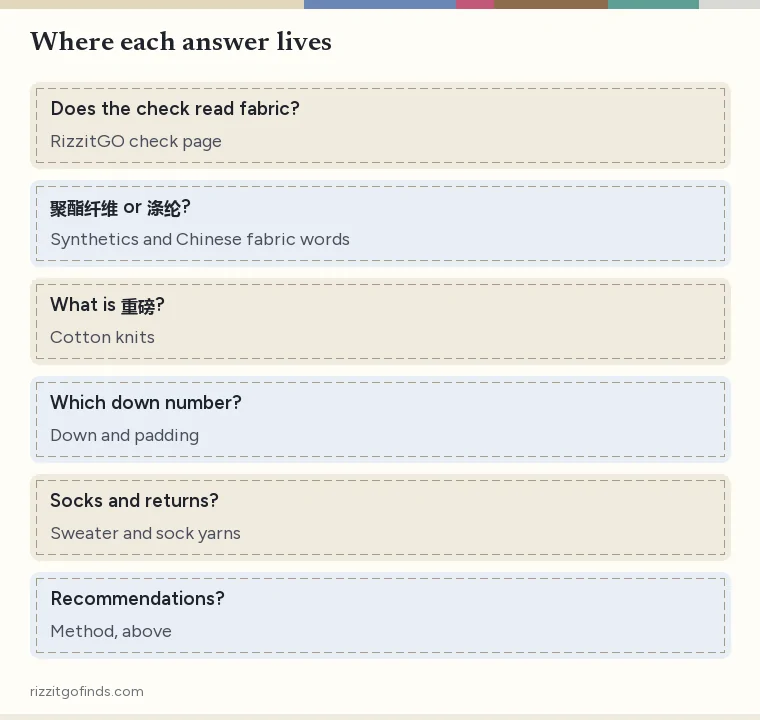
These are not frequently asked questions gathered from readers; they are the points the fiber pages keep returning to, answered in a line or two. Each answer points to the page with the full version.
Does RizzitGO check what my clothes are made of?
Ordinary visual QC does not certify fiber composition. RizzitGO’s buying guide describes arrival checks and photos, while forwarding inspection terms have their own scope and exclusions. See the RizzitGO check page.
Is 聚酯纤维 different from 涤纶?
No, both are polyester: the first is the formal label name, the second the trade name.
What does 重磅 mean on a tee?
It is a seller’s comparative word for heavyweight, not a standard cutoff. Ask for fabric weight in g/m² and confirm it is not the whole garment’s weight.
Which number matters on a down jacket?
Ask for both down content (含绒量) and fill weight (充绒量) for your size. Loft, construction, fit and conditions also affect warmth; the percentage alone cannot rank two jackets.
Can I return socks bought through RizzitGO?
RizzitGO’s return table puts underwear, socks and leggings outside its five-day return guarantee.
Does this site recommend sellers or products?
No. It reads fiber and leaves the choice to you.