Denim in a RizzitGO order: ounce weight, stretch and rigid cotton
Jeans are the one garment where two numbers, the weight of the cloth and the share of elastane, predict most of how the pair will feel. Chinese listings print them in their own way, when they print them at all.
Denim weight and the stretch share
Two figures describe most of what a pair of jeans will feel like before you try it: the weight of the denim and how much elastane is in it. Chinese listings give the first as 克重 in grams or in ounces (盎司, often written oz), and the second inside the composition line, for example 棉 98% 氨纶 2%.
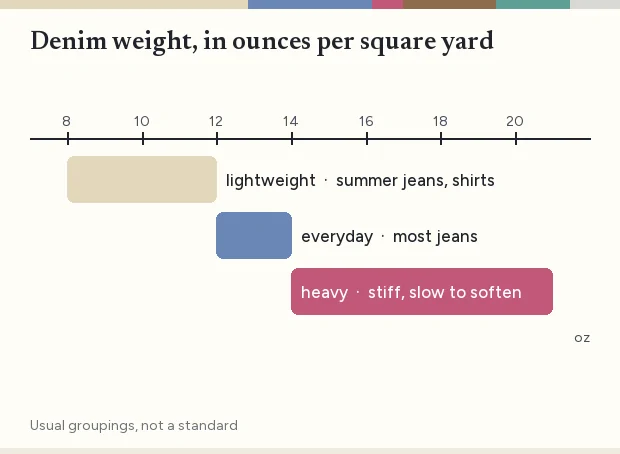
By the usual trade groupings, denim under about 12 ounces per square yard reads as lightweight, roughly 12 to 14 ounces is the everyday middle, and anything above 14 is heavy, the stiff kind that takes weeks to soften. A small elastane share may add give, but weave, cut and finishing also affect comfort; the percentage alone cannot predict fit.
Many jeans listings give neither figure and say only 弹力 (stretch) or 无弹 (no stretch). That is a direction, not a measurement, and the question to send is the elastane share and the weight.
Ounces and grams per square meter
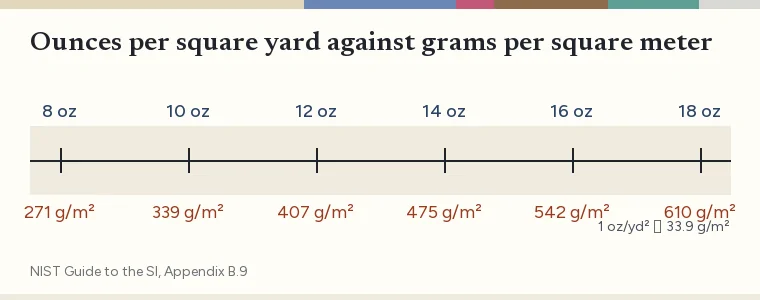
The conversion is exact enough to do in your head once you know the factor. NIST’s conversion table gives one ounce per square yard as 3.390575 × 10⁻² kilograms per square meter, which is about 33.9 grams per square meter.
| Denim weight | Same weight in g/m² |
|---|---|
| 10 oz/yd² | 339 g/m² |
| 12 oz/yd² | 407 g/m² |
| 14 oz/yd² | 475 g/m² |
| 16 oz/yd² | 542 g/m² |
So a listing that says 克重 400g is roughly a 12 ounce denim, and one that says 14oz is about 475 grams per square meter. Watch for listings that give a garment weight in grams instead; a figure such as 600 or 700 grams could refer to a whole pair or a heavy fabric. Ask for the unit and basis rather than deciding from the number alone. Source: NIST Guide to the SI, Appendix B.9.
Rigid cotton denim and the first weeks
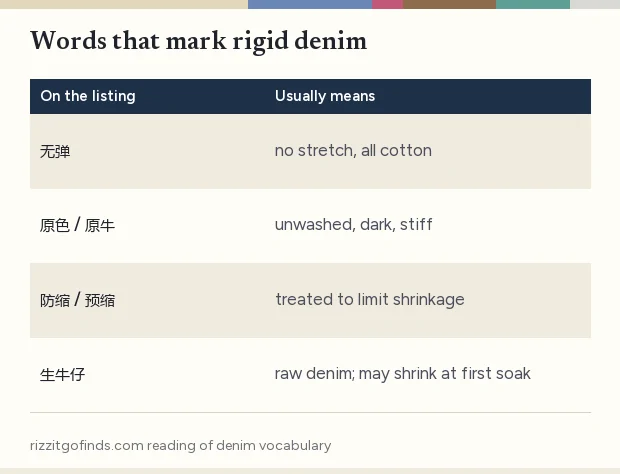
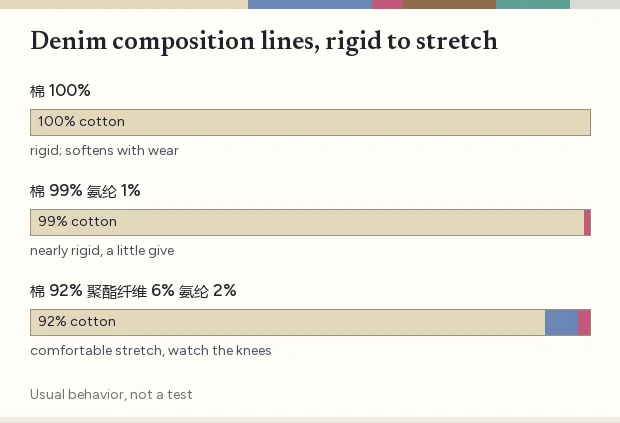
Rigid denim is all cotton with no stretch. Listings call it 无弹, and darker unwashed versions 原色 (raw color) or 原牛 (raw denim). It starts stiff, sometimes uncomfortably so, and softens with wear as the yarns flex.
Most rigid denim sold today has been treated to limit shrinkage, written 防缩 or 预缩 on some listings. Truly untreated raw denim can shrink noticeably at the first soak, and people who buy it usually plan for that; a listing that sells raw denim usually says so, and silence does not establish that a pair is pre-shrunk. If the difference matters to you, ask before ordering, because no warehouse check will soak the pair.
Rigid denim also holds creases where you bend, the faded lines that develop at the hips and behind the knees. That is a feature to some buyers and a nuisance to others.
Stretch denim and recovery
Stretch denim adds elastane to the cotton, usually a small share. Around 1 to 3 percent is typical for jeans that feel like ordinary denim but give when you move; higher shares and added polyester produce the very soft, very stretchy jeans that behave more like a knit.
Recovery is the word that matters. Good stretch denim springs back after a day of sitting; poorer stretch denim stays stretched at the knees and seat, and the jeans look a size bigger by evening. More elastane does not guarantee better recovery, and elastane weakens with heat, so hot dryers shorten its life.
A line such as 棉 92% 聚酯纤维 6% 氨纶 2% describes a stretch denim with some polyester for shape. A line of 棉 99% 氨纶 1% is a jean that feels nearly rigid with a little give.
Indigo that rubs off, and the names of washes
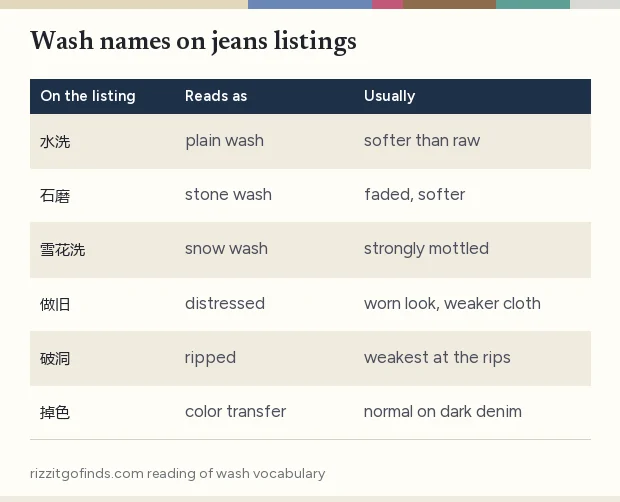
Indigo dye sits on the surface of the yarn, which is why denim fades so well and why new dark jeans can leave blue on light sneakers, sofas and the inside of a bag. That transfer, 掉色 on listings, is normal for dark rigid denim and usually lessens after several washes.
Wash names describe how the color was treated before sale. 水洗 is a plain wash; 石磨 (stone wash) is faded and softer; 雪花洗 (snow wash) is the strongly mottled look; 做旧 means distressed and 破洞 means ripped. Heavily treated denim is softer from day one but has been weakened by the treatment, especially around rips.
Photos show the shade well, though screens and warehouse lighting shift indigo more than most colors. The published forwarding inspection terms exclude color differences; so a shade that matters to you is worth comparing across several photos on the listing.
Jeans in the catalog
Jeans have a shelf of their own in the product catalog: the jeans shelf. On this site they appear as a text entry rather than a photo card: the shelf has photos of its own, and a single picture of one pair would say little about the cloth of the next.
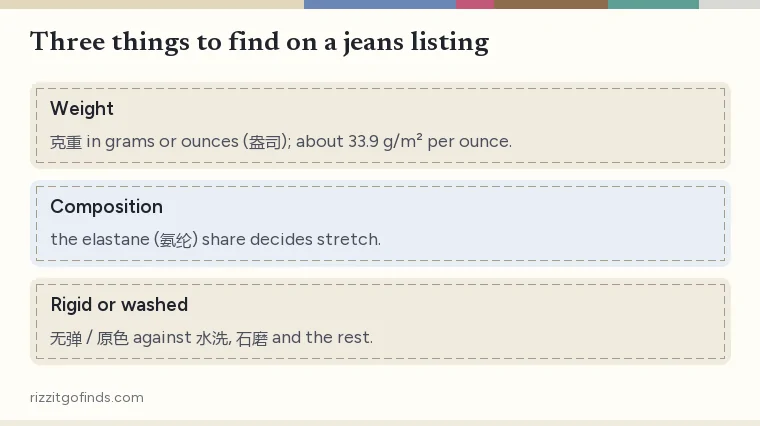
When you open a jeans listing from that shelf, three things are worth finding before anything else: the weight, the composition with its elastane share, and whether the denim is rigid or washed. If any of the three is missing, ask through RizzitGO’s order enquiry before paying. Warehouse overview photos do not establish stretch recovery or shrinkage. Ask what measurements or extra photos are available for your order.
Denim jackets follow the same rules, usually in rigid or near-rigid cotton, and often heavier than the jeans from the same seller.