Synthetic and stretch fabrics in a RizzitGO order
Polyester, nylon and elastane sit in sports tees, shorts, leggings, shells and the outer cloth of puffers. Their names on a Chinese listing are few and fixed; the selling words around them are not.
Polyester under two names
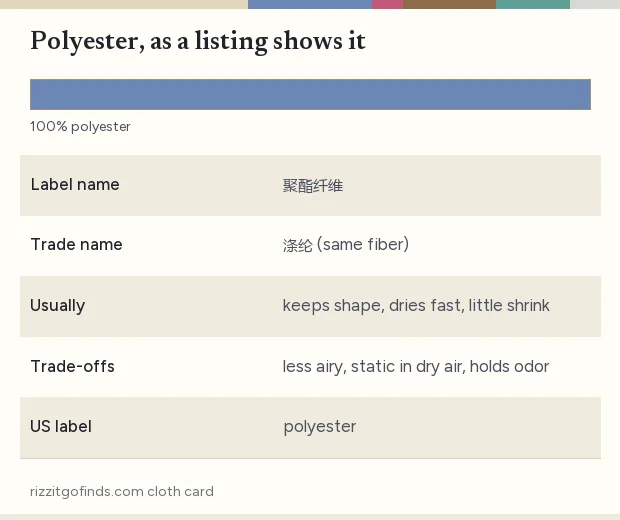
Polyester is the most common synthetic in the catalog, and on Chinese listings it goes by two names. 聚酯纤维 is the formal name that labels are supposed to use; 涤纶 is the everyday trade name and still appears on many tags and in most titles. They are the same fiber.
In wear, polyester usually keeps its shape, resists wrinkles, dries quickly and shrinks very little. It also absorbs almost no water, so sweat stays on the skin or moves along the fabric rather than soaking in; a knit built for sport uses that to wick, a cheap shirt just feels clammy. It gathers static in dry air and, as the last section on this page explains, tends to keep body odor longer than cotton.
In US labeling the generic name is simply polyester, defined in the FTC’s textile rules by its chemistry. The same rules make every fiber at 5 percent or more appear by its generic name on a US label, which is why a US tag may read differently from a Chinese one for the same garment.
Nylon where rubbing and weight matter
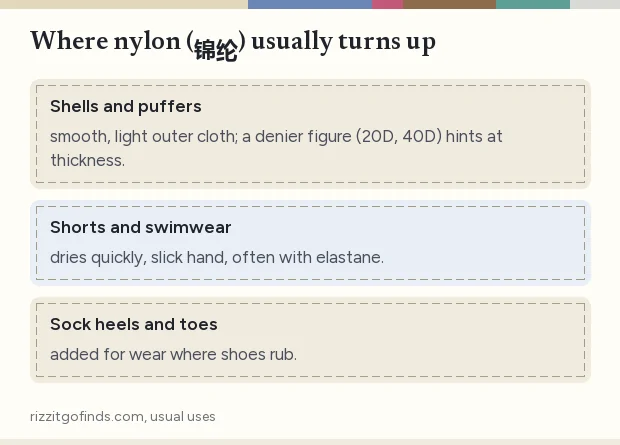
Nylon, written 锦纶 on labels and 尼龙 in many titles, is the synthetic chosen when a fabric has to take abrasion or stay light. It shows up in shell jackets, swim and board shorts, the heels and toes of socks, and the outer cloth of many puffers.
It usually feels smooth and cool rather than soft, dries quickly, and is stronger than polyester for the same weight. A thin nylon shell can feel crisp and a little noisy. Nylon knits with elastane are the stretchy, slippery fabrics of leggings and some cool-touch tees.
Listings sometimes add numbers like 20D or 40D to a nylon fabric. Denier describes yarn linear density. A lower value can mean a lighter yarn, but weave, fiber and finish also affect the finished cloth; the number alone does not prove durability. Few listings explain it, but it is a useful clue on a shell or a puffer.
A little elastane, and what it changes
Elastane is the stretch fiber. Chinese labels call it 氨纶; in the United States the generic name is spandex, and the FTC rules define it as a fiber made of at least 85 percent segmented polyurethane. A small amount changes a fabric more than any other fiber at the same share.
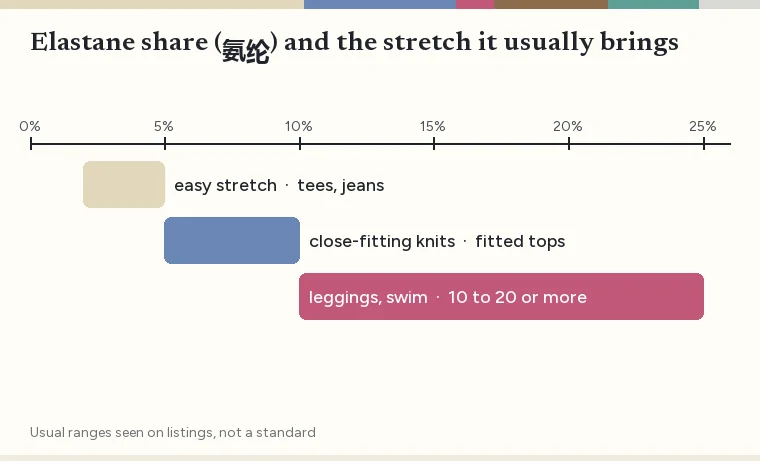
Shares on listings usually fall into rough groups. Around 2 to 5 percent gives a tee or a pair of jeans easy stretch and helps it spring back; around 5 to 10 percent makes a close-fitting knit; leggings, swimwear and compression pieces usually carry 10 to 20 percent or more. Elastane does not last forever: heat, chlorine and long wear weaken it, and the first sign is usually a cuff, waistband or knee that stays stretched.
The FTC rule on small shares is worth knowing because it explains why elastane is printed at all. On a US label, a fiber under 5 percent is normally listed only as “other fiber”, unless it has a clear functional significance; the regulation’s own example is a fabric of 96 percent acetate and 4 percent spandex. Stretch is exactly that kind of function, so a small elastane share gets named.
Read with the FTC textile rules (16 CFR Part 303); percentages above are usual ranges seen on listings, not rules.
Quick-dry and ice-silk as seller words
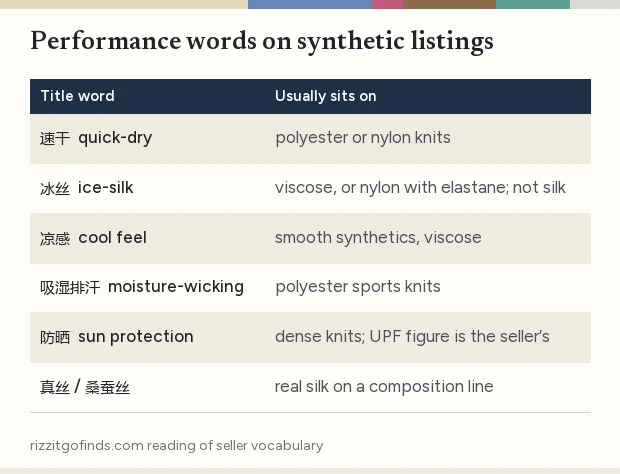
Sportswear and summer listings carry their own vocabulary, and very little of it names a fiber. 速干 (quick-dry) usually sits on polyester or nylon knits; a cotton-heavy composition under that word deserves a second look. 冰丝 (ice-silk) is a cool-touch selling name, usually for viscose or a nylon and elastane knit; the term does not establish silk content; silk would read 桑蚕丝 or 真丝 on the composition line.
凉感 (cool feel) describes how the fabric feels on first touch, which smooth, dense synthetics and viscose do well. 吸湿排汗 (moisture-wicking) is a performance claim that usually means a polyester knit built to move sweat along the fabric. 防晒 (sun protection) may come with a UPF number; that figure is the seller’s, and nothing in a warehouse check tests it.
The habit that helps: let the title tell you what the seller wants you to feel, then let the composition line tell you what the cloth is.
Shell fabrics: water-repellent is not waterproof
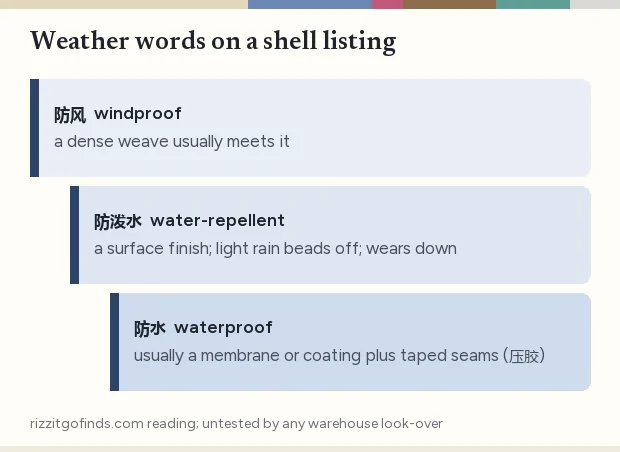
A shell jacket is a woven nylon or polyester outer cloth, and its listing makes weather claims in a ladder of words. 防风 (windproof) is the easiest to meet with a dense weave. 防泼水 (water-repellent) means a finish that makes light rain bead and roll off; it usually wears down with washing and rubbing. 防水 (waterproof) means something stronger, and on a real waterproof jacket it usually comes with a membrane or coating and taped seams, written 压胶 on many listings.
A listing that says waterproof but shows neither a coating nor taped seams is making the easy version of the claim. The lining matters too: a mesh or polyester taffeta lining (里布) is common, and a padded lining turns a shell into a light jacket.
RizzitGO’s check does not spray water on anything. Water claims stay untested until the first rain.
Odor and static, the trade-offs of a synthetic
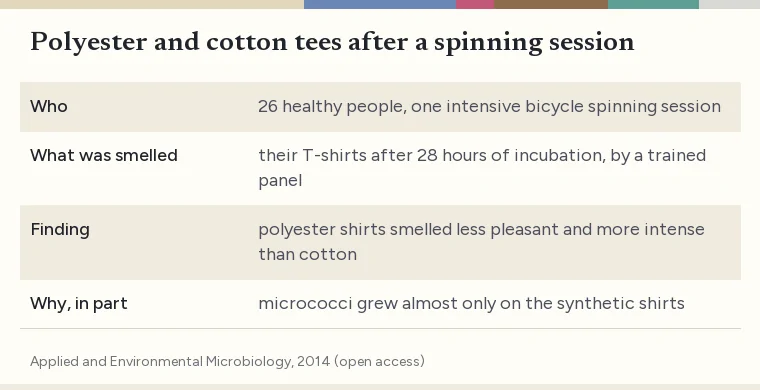
The odor point is not folklore. A study published in Applied and Environmental Microbiology in 2014 collected T-shirts from 26 people after an intensive spinning session and had a trained panel smell them after incubation. The polyester shirts smelled significantly less pleasant and more intense than the cotton ones, and the researchers found micrococci growing almost only on the synthetic fabric.
That study describes its tested shirts and exercise conditions; it does not establish how every blend or a finished product behaves after washing. It matters most for pieces worn close to the skin, such as base layers, sports tees and fleece worn without a layer underneath. Static is the other everyday trade-off, strongest in dry winter air and on fleece and acrylic.
None of this makes synthetics a bad choice; they dry fast, last and keep their shape. It just means the composition line predicts how a piece will feel by the end of a long day, not only on first touch. Study: Microbial Odor Profile of Polyester and Cotton Clothes after a Fitness Session (Applied and Environmental Microbiology, 2014).