Down and padded jackets in a RizzitGO order, read by their fill
A puffer listing can say a great deal about the shell and very little about the inside. Warmth lives in the fill line, and in two numbers that sellers do not always print together.
Down fill and padding on a puffer listing
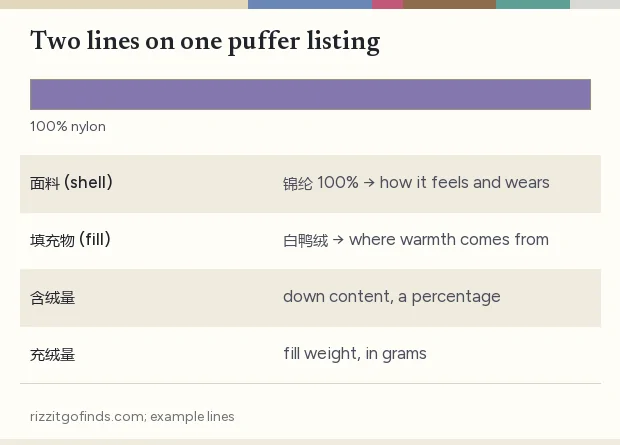
A padded jacket has two compositions, and listings do not always show both. The first describes the shell: 面料 or 面料成分, usually 锦纶 (nylon) or 聚酯纤维 (polyester), sometimes cotton. The second describes what is inside, under 填充物 (fill): down, a down and feather mix, or polyester padding.
Warmth comes from the fill, so a listing that only gives the shell has left out the part that matters. When the fill is down, two more figures should follow: the down content, 含绒量, and the fill weight, 充绒量. Both are explained in the next section.
If the reader on the home page gets a shell composition with the garment set to a down jacket, it says so for this reason. A line like 锦纶 100% tells you how the jacket will feel to touch and how it will take a scrape, not how warm it will be.
Down content and fill weight are different numbers
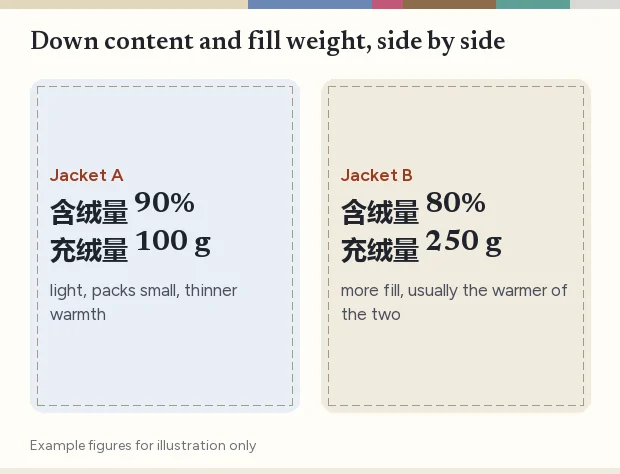
含绒量 (down content) is a percentage: how much of the fill is down clusters, the soft, quill-less plumes, as opposed to small feathers. A listing that says 90% 白鸭绒 or 90/10 means about nine parts down to one part feather by weight. Higher down content usually means a lighter, puffier fill that packs smaller.
充绒量 (fill weight) is a weight: how many grams of fill are inside the jacket, often for one stated size. A 90 percent jacket with 100 grams of fill can be much less warm than an 80 percent jacket with 250 grams. Warmth also depends on fill loft, baffle construction, fit and conditions; no one figure reliably ranks two finished jackets.
Sellers sometimes give only the flattering number: a high down content with no fill weight is common on thin, light puffers. Asking for both figures, for your size, is the single most useful question on this shelf.
Duck, goose, white and gray
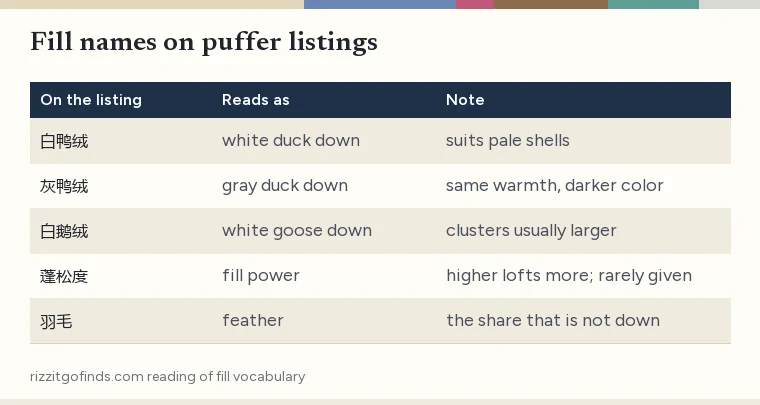
The fill line usually names the bird and the color: 白鸭绒 (white duck down), 灰鸭绒 (gray duck down), 白鹅绒 (white goose down). Color is about appearance: white down is preferred under pale shells, where gray down might show through, and does not change warmth.
Goose down clusters are usually larger than duck down clusters, which tends to give more loft for the same weight; that is the main reason goose fill costs more. Some listings give a fill power figure, 蓬松度, measured as the volume one ounce of down fills. A higher fill power means the down lofts more. Few mid-priced listings print it, and none of the figures can be checked from photos.
New down can smell faintly animal, especially when damp; the smell usually fades as the jacket airs. A persistent or unusual odor should be raised with the seller; a description or photo cannot establish its cause.
Polyester padding and the coats called cotton
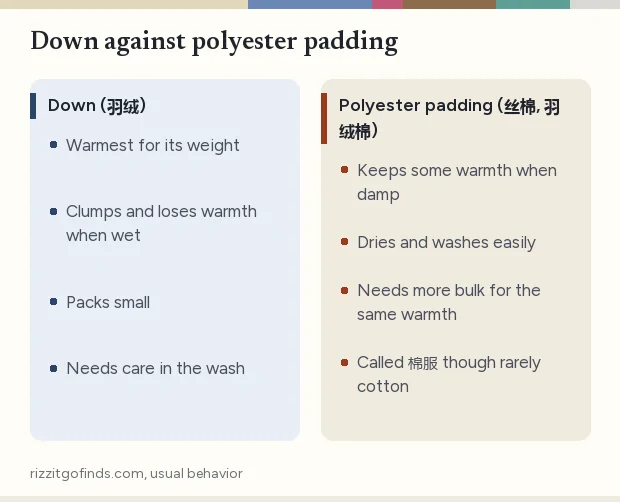
Not every padded coat is down. 棉服 translates as cotton coat, but in practice it is the everyday name for a padded coat, and the padding is usually polyester fiberfill, not cotton. The fill line will say 聚酯纤维 or use names like 丝棉. 羽绒棉 is a selling name for a synthetic made to stand in for down; despite the name it is usually polyester.
Polyester padding behaves differently from down. It usually keeps more of its warmth when damp, dries faster and washes more easily, but it needs more bulk or weight for the same warmth and does not compress as small. For a coat that will meet rain or a washing machine often, that can be the better trade.
The listing should still give a fill weight for synthetic padding, sometimes as grams per square meter of batting rather than grams per jacket. As with down, a figure with no unit and no size attached says little.
Shell cloth and the feathers that work through
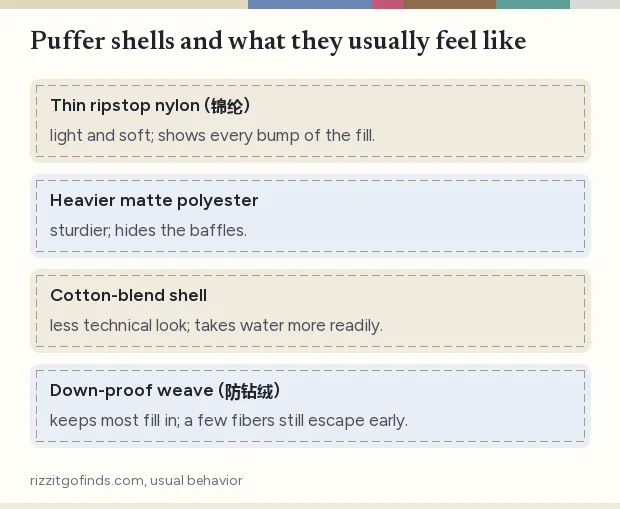
Down is held in by the shell, and a light shell has to be woven tightly enough to keep the fill from escaping. Listings sometimes call such fabric 防钻绒 (down-proof). Even with it, a few fibers or the tip of a feather usually work through the seams and stitching, more in the first weeks and more with higher feather shares, because feather quills are stiffer than down clusters.
A shell’s weight and finish change the feel. Thin ripstop nylon is light and soft and shows every bump; a heavier matte polyester feels sturdier and hides the baffles; a cotton-blend shell looks less technical and takes water more readily. Water-repellent finishes on puffers behave as they do on any shell: they bead light rain and wear down with use.
Do not pull an emerging feather outward. If it is still caught in intact fabric, gently draw it back from the opposite side, following the garment maker’s care guidance. A tear needs repair. Patagonia’s repair guide illustrates this inward approach (checked 18 October 2026).
What a warehouse can and cannot see on a puffer
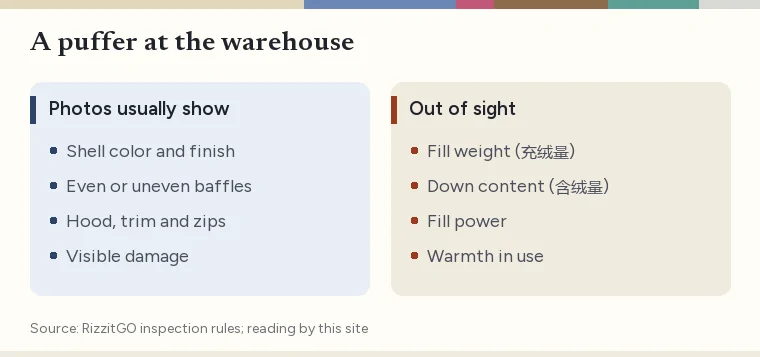
RizzitGO’s public guide describes arrival checks and photos, with a separate undefined standard for 1688 purchases. A normal visual check of a closed puffer cannot verify its fill composition or fill weight. An item’s total scale weight includes the shell and hardware, so it is not proof of the amount of down inside.
What the photos can show is useful in its own way: the color of the shell, whether the baffles look evenly filled, the hood and trim, and any visible damage. A jacket photographed flat and thin after packing may still loft once it is hung up and shaken out at home.
So the fill figures have to be settled before purchase, through the listing and, if they are missing, through the order enquiry route on the RizzitGO check page.