Cotton knits in a RizzitGO order: jersey tees, terry and fleece hoodies
Tees, sweatshirts and joggers are mostly cotton knits, alone or blended with polyester. The listing tells you more about them than the photos do, if you know where the weight and the knit name hide.
Gram weight on a tee or hoodie listing
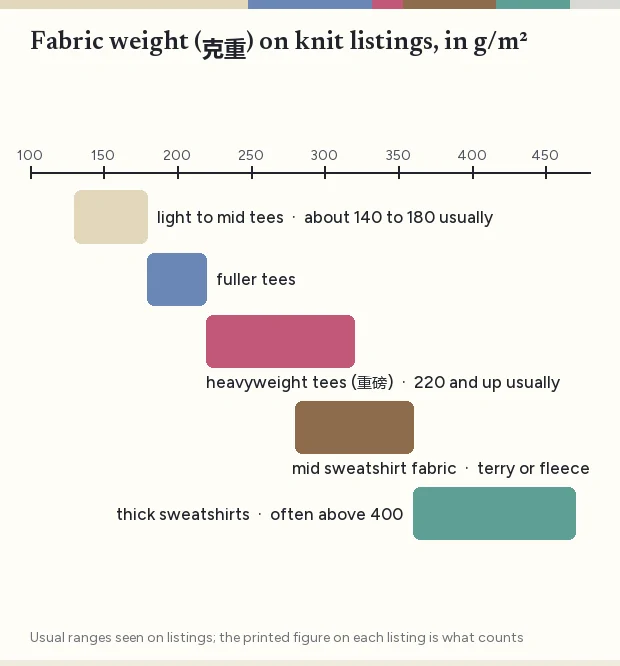
When a knit listing gives its weight, it usually appears as 克重 followed by a number of grams, often in the title as well as the parameter block: “260g重磅”, “克重 220g”. In most cases that number is the weight of one square meter of the fabric, the figure the trade calls gsm. Some sellers quote the weight of the finished garment instead, and the listing rarely says which, so a number that looks odd for the garment type is worth a question.
As a rough guide, and only as that: plain tees usually sit somewhere around 140 to 180 gsm, which reads as light to mid; listings that lean on the word heavyweight usually quote 220 gsm or more, and some boxy tees go well past 300. Sweatshirt fabric starts heavier, with mid-weight terry and fleece usually in the high 200s to mid 300s and the thick ones above 400.
Fabric weight is one clue, not a warmth or quality rating. Knit construction, finishing and fit also affect drape, airflow and drying. Compare the same unit and ask whether a quoted gram figure describes fabric or the whole garment.
A quick sense check helps: a listing that pairs a summer-thin description with 300g, or a heavyweight claim with 160g, may be quoting the garment rather than the fabric, or may have carried a figure over from another listing. Either way, it is a number worth asking about.
Heavyweight, combed and fleece-lined as title words
Chinese tee and sweatshirt titles are dense with fabric words, and only some of them describe the fiber. Three turn up constantly.
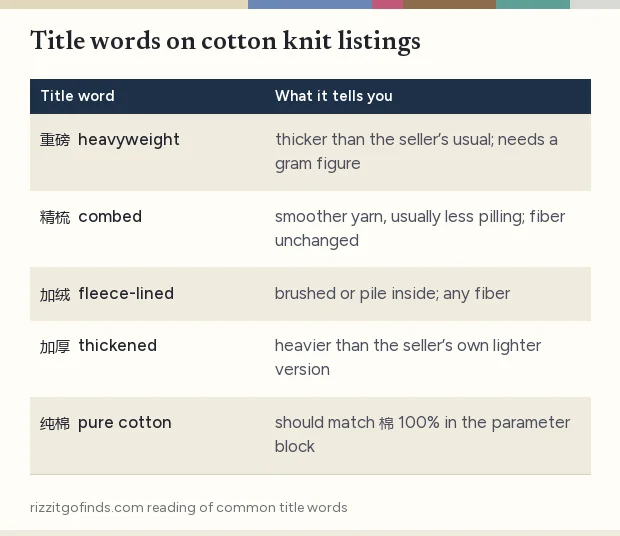
重磅 (heavyweight) is a comparison, not a measurement: heavier than the seller’s idea of normal. With a gram figure next to it, it means something; without one, it is a mood. 精梳 (combed) is about the yarn: the short fibers were combed out before spinning, which usually gives a smoother, slightly shinier surface that pills less. The composition line still reads 棉 (cotton). 加绒 (fleece-lined) means the inside face was brushed or given a pile, so the piece feels warmer and softer against the skin; it says nothing about which fiber was brushed, and a fleece-lined hoodie can be cotton, polyester or both.
Two more are worth a pause. 加厚 (thickened) only compares the piece with the same seller’s lighter version. 纯棉 (pure cotton) in a title is a claim the parameter block should repeat as 棉 100%; when the two disagree, ask which composition applies to your selected variant rather than choosing the more reassuring claim.
Jersey, terry and brushed fleece
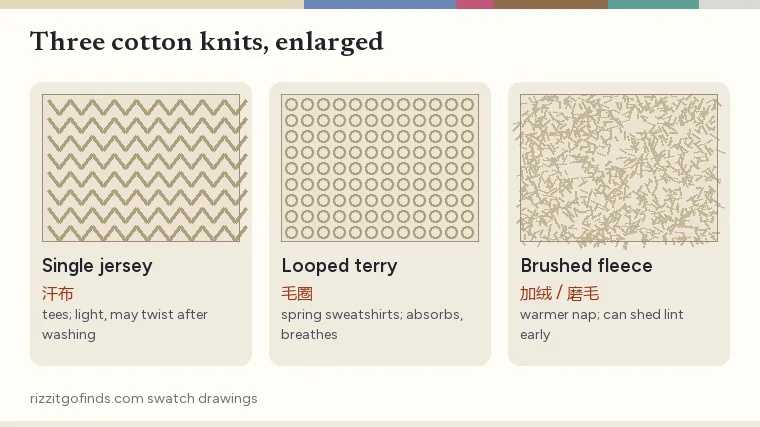
Most cotton clothing in the catalog is knitted, and three knits cover nearly all of it. Single jersey (汗布) is the tee fabric: smooth on the face, small loops on the back, light and stretchy across the width. It is also the knit most prone to twisting after washing, when the side seams creep toward the front; cheaper, loosely knitted jersey usually twists more.
Terry (毛圈, French terry 法国毛圈) keeps small yarn loops on the inside. It absorbs well, breathes, and suits spring and autumn sweatshirts. Brushed fleece (加绒, 磨毛) starts as the same kind of looped knit and is then brushed until the loops break into a soft nap. It traps more air, so it is warmer, but the nap can shed lint in the first washes and flatten over time.
Two others appear often enough to know by name. Piqué (珠地) is the textured knit of polo shirts, a little stiffer and more breathable than jersey. Rib (罗纹) has vertical ridges and real stretch; it makes collars, cuffs and waistbands, and it is the part of a cotton garment most likely to carry elastane.
Cotton, polyester and the blends between them
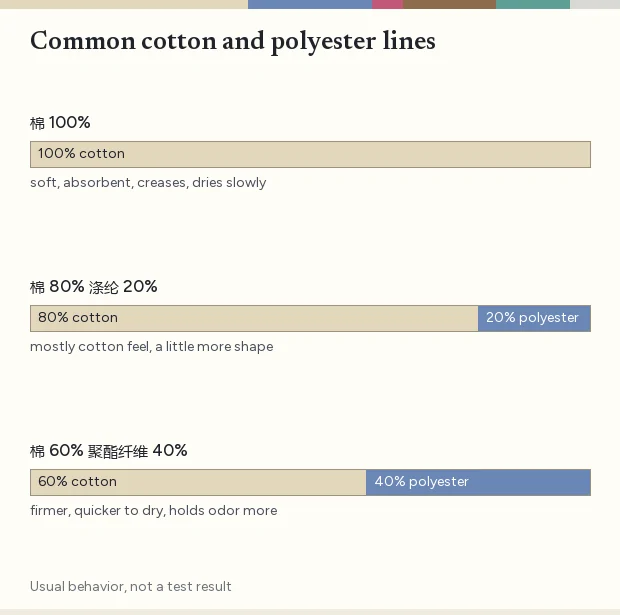
A large share of knit listings are not pure cotton. The usual reasons are cost, shape retention and drying time, and a composition line will normally show the split: 棉 60% 聚酯纤维 40%, or 棉 80% 涤纶 20%.
In wear, a blend usually sits between its fibers in proportion. More polyester means a garment that keeps its shape, wrinkles less, dries faster and shrinks less, at the price of a slightly less airy feel, more static in dry weather and a tendency to hold on to sweat odor. More cotton means a softer, more absorbent piece that creases and dries slowly. A small polyester share in a fleece also helps the brushed nap last.
One detail catches people out: on many tee listings the heather or marled colors, 花灰 for example, carry a different composition from the solid colors in the same listing, because the mottled look comes from mixing two fibers. If the color you want is a heather, look for a composition note tied to that color. The split is also the fairest way of deciding what to buy between two tees at the same price: the one with more polyester usually keeps its shape longer and feels a little less airy.
The first wash: shrink, twist and fading
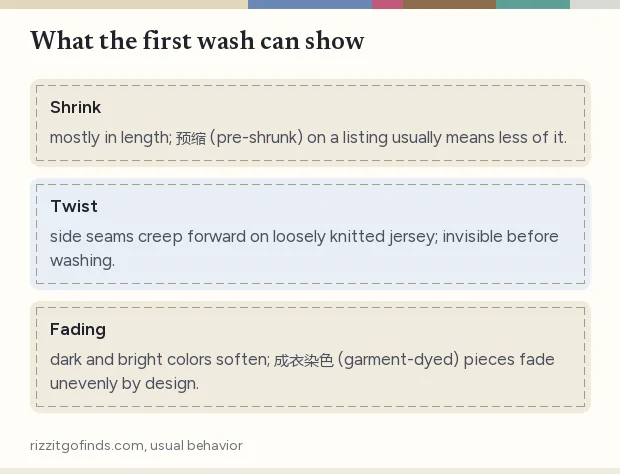
Untreated cotton knits usually shrink a little the first time they meet warm water and a dryer, mostly in length. Listings that mention 预缩 (pre-shrunk) or a garment wash have usually taken some of that shrink out before sale. Nobody can promise a figure: it depends on the yarn, the knit and how the piece is washed. A cool wash and line drying usually keep the change smaller.
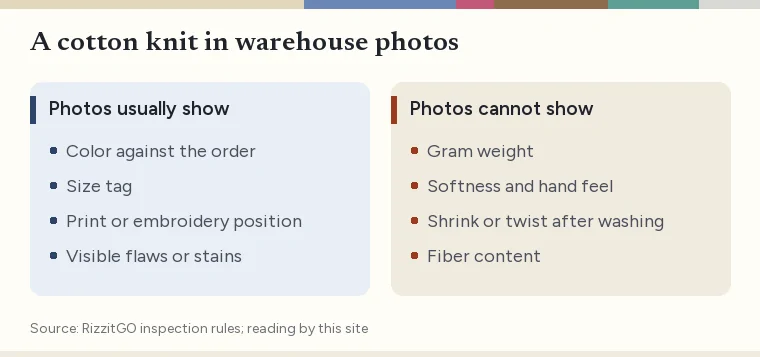
Twist is the other surprise. Jersey that was knitted in a tube and cut without being straightened can rotate after washing, so a side seam ends up across the front of the leg or torso. It is a fabric trait, not damage, and photos taken in the warehouse, before any washing, cannot show it.
Dark and bright cotton colors fade with washing and sun. Garment-dyed pieces, sold as 成衣染色, usually have a softer, uneven color on purpose and may fade more visibly at seams.
Cotton knits and the RizzitGO check
RizzitGO’s buying guide describes arrival checks and photos. Its separate forwarding rules mention count, color and size but also contain exclusions. Use the actual photos to compare your variant, print placement and visible size tag; ask for a close-up when those details are not shown.
A normal overview photo does not measure gsm, softness or wash performance. Reading the QC photos for a cotton knit is mostly a color and size exercise; fiber has to be settled on the listing before you buy. If the listing is silent on weight or composition, the order enquiry button that RizzitGO describes for the purchasing stage is the way to ask the seller through its staff. RizzitGO also sells a customized photography service at the warehouse; it does not publish a price for it.
Prints are the one part of a tee the photos describe better than the listing. A rubbery, slightly raised print is usually 胶印 (plastisol), which sits on top of the cloth and can crack after many hot washes; 水印 (water-based) soaks into the fibers and feels soft; 烫画 is a heat transfer pressed on. The listing word tells you how a print usually ages, and the photo tells you where it sits.