Chinese fabric words on a listing, matched to their English names
Most of what a Chinese listing says about cloth fits into a few dozen words. This page lists them as they appear, so you can match a composition line, a color name or a care instruction to plain English.
Chinese fiber names on Taobao and 1688 listings
A composition line on a Chinese listing uses a small, fixed set of fiber names, and once you know a dozen of them you can read most clothing. The table under this section gives the names as they usually appear, the English fiber, and where you will meet them.
Two habits help. First, the formal names, 聚酯纤维 for polyester and 粘纤 for viscose, and the trade names, 涤纶 and 人造棉, mean the same fibers; neither is better. Second, identify the percentage attached to each fiber. Layout and order vary; a fiber name alone does not give the full composition.
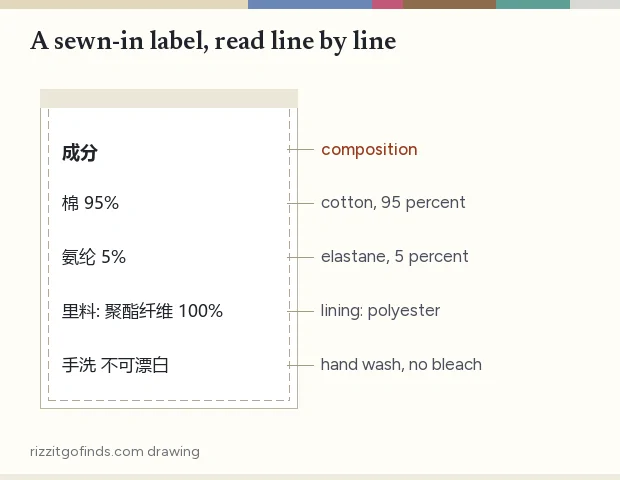
The sewn-in label in the drawing shows the usual order: the word 成分 (composition), then each fiber with its share, largest first, then any lining or trim on its own line, and the care words last. Real label layouts vary, so check which figures belong to the shell, lining, fill or trim.
| On the listing | English fiber | Usual garments |
|---|---|---|
| 棉, 纯棉, 全棉 | cotton; 纯棉 and 全棉 claim all cotton | tees, hoodies, denim |
| 聚酯纤维, 涤纶 | polyester; same fiber, formal and trade name | fleece, sportswear, padding |
| 锦纶, 尼龙 | nylon (polyamide) | shells, socks, swimwear |
| 氨纶 | elastane, called spandex in the US | stretch in jeans, tees, leggings |
| 粘纤, 粘胶纤维, 人造棉 | viscose (rayon) | drapey tops, dresses, knits |
| 莫代尔 | modal | soft tees, underwear |
| 腈纶 | acrylic | sweaters, scarves |
| 羊毛, 绵羊毛 | wool, sheep wool | knits, coats |
| 羊绒 | cashmere | fine knits |
| 亚麻, 棉麻 | linen; cotton and linen | summer shirts, trousers |
| 桑蚕丝, 真丝 | silk | shirts, scarves |
| 羽绒, 白鸭绒, 白鹅绒 | down; white duck, white goose | puffer fill |
Where the composition sits on a listing
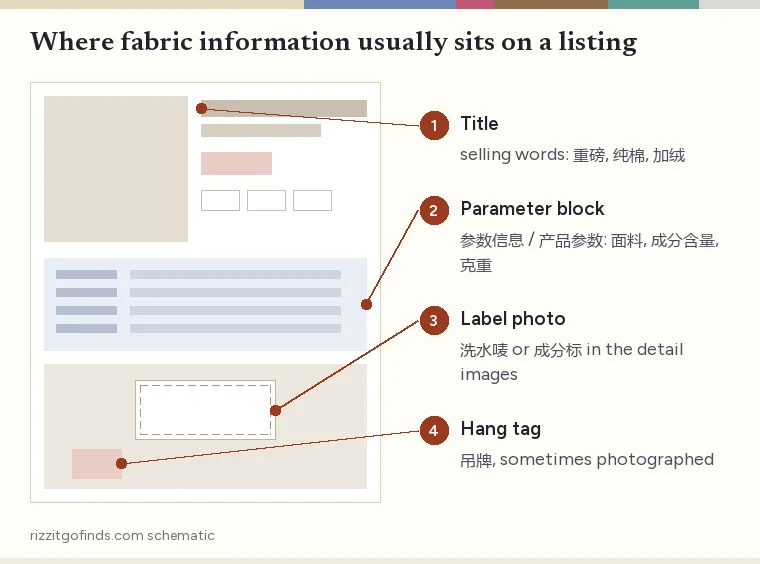
On a Taobao or Tmall listing the composition is usually in the parameter block, often headed 参数信息, as fields such as 面料, 材质成分 or 成分含量. On a 1688 offer page it usually sits in the product attribute list, with fields such as 面料名称, 主面料成分 and 主面料成分的含量, and a 克重 field for knits. Further down, the detail photos often include the sewn-in label, called 洗水唛 or 成分标, and the hang tag, 吊牌. The title may repeat some of this in selling words.
When those places disagree, ask the seller which composition applies to the exact variant and request a corresponding label photo. Any listing photo can be old or belong to another batch. Save the answer; neither the title nor a photographed label is an independent fiber test.
One honest limit on this page: when we tried on 17 October 2026, Taobao and 1688 listing searches would not load without signing in, and RizzitGO’s own search returned no results until signed in. Seven public Weidian item pages opened fine but had no parameter block at all; any fiber detail sat in the photos. So the field names above are what these platforms usually show, not a fresh capture.
Title words against the composition line
Titles are written to be found, so they carry the words buyers search for: 纯棉, 重磅, 羊毛, 冰丝. The composition line is where the seller commits to percentages. The two can disagree, and the common patterns are easy to spot once you look for them.
- A title says 纯棉 (pure cotton) while the parameter block reads 棉 60% 聚酯纤维 40%.
- A title says 羊毛 or 羊绒 while the line shows a small wool share and a large 腈纶 (acrylic) share.
- A title says 含棉 (contains cotton), which promises some cotton and no particular amount.
- A puffer title gives 90% down content while the fill weight is missing altogether.
Choosing a seller between two near-identical listings is easier when one of them fills in its composition and the other does not: you know what you are reading. It does not tell you either listing is accurate, only which one gave you something to read.
Color names in a listing versus the dye that arrives
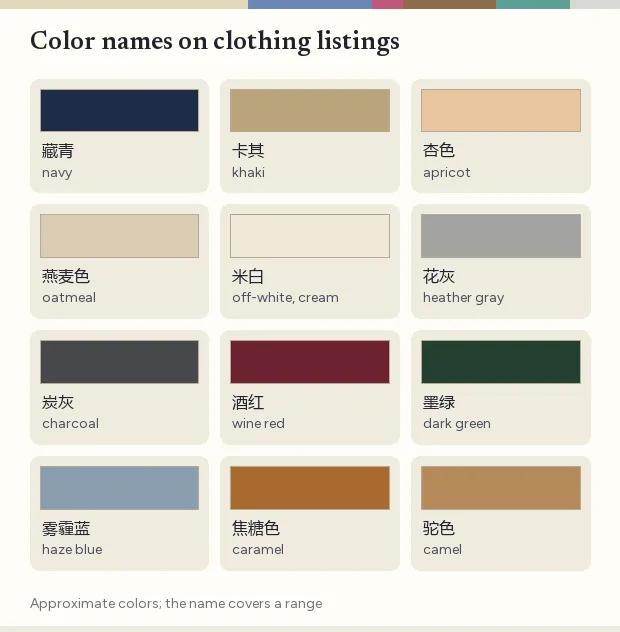
Color names on listings are a vocabulary of their own, and a few do not translate the way you expect. 藏青 is navy, not a green-blue. 卡其 is khaki, which on Chinese listings ranges from sand to olive brown. 杏色 (apricot) and 燕麦色 (oatmeal) are both pale, warm neutrals that photograph almost identically. 花灰 is heather gray, a mottled gray made by mixing fibers or yarn colors.
The color you receive can still differ from the photo. Screens shift colors, studio photos are often brightened, and different dye lots of the same cloth vary. The forwarding inspection terms mention a color check but exclude color differences. Compare the ordered variant with the actual QC images and ask about a mismatch; do not treat warehouse lighting as a color measurement.
If a shade really matters, compare it across several listing photos, including any taken outdoors, and read the name as a family of colors rather than a single one.
Two names cause the most surprises in practice. 米白 (off-white) usually has a yellow or gray cast that only shows beside pure white, and 卡其 (khaki) moves so far between sellers that the photo matters more than the word.
Care words and the symbols beside them
The sewn-in label that carries the composition usually carries the care instructions too, in Chinese words, in symbols, or both. They are worth reading before you buy, because they tell you what the maker expects the fabric to tolerate.
| On the label | Means |
|---|---|
| 手洗 | hand wash |
| 机洗 | machine wash |
| 水温不超过30°C | water no hotter than 30°C |
| 不可漂白 | do not bleach |
| 不可滚筒烘干 | do not tumble dry |
| 平铺晾干 | dry flat |
| 低温熨烫 | iron on low heat |
| 不可干洗 | do not dry clean |
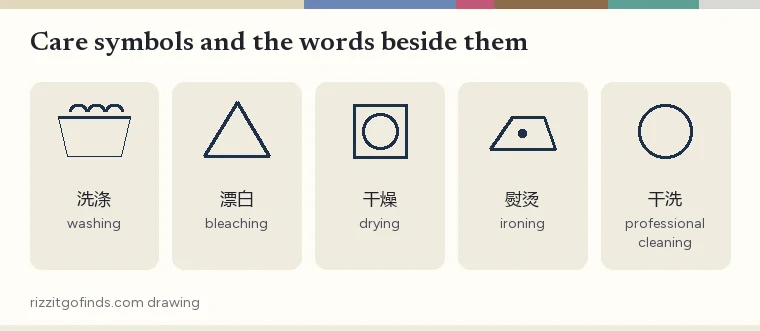
A cotton tee labeled 手洗 or a sweater labeled 平铺晾干 is telling you how it is likely to react to a hot machine and a dryer. The symbols follow the usual international set: a tub for washing, a triangle for bleach, a square for drying, an iron, and a circle for professional cleaning.
A short glossary of label words
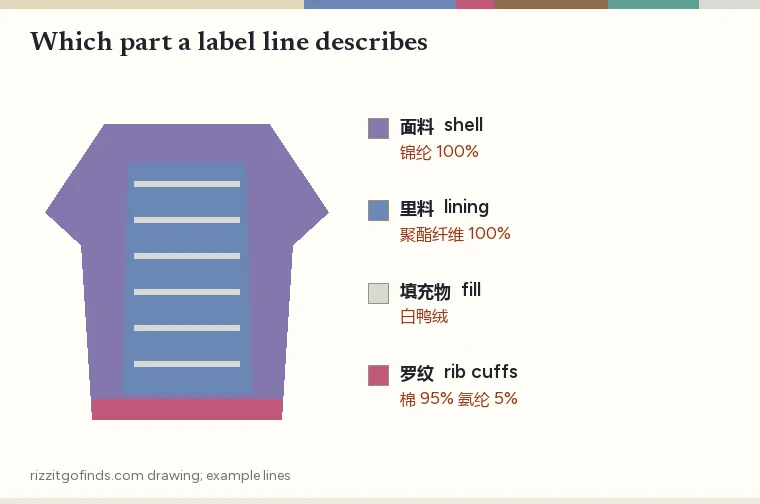
Beyond fiber names, a handful of label words tell you which part of a garment a line describes. Jackets and panelled tops often have more than one composition, and the word in front of the line says which piece it belongs to.
| Word | Meaning |
|---|---|
| 面料 / 主面料 | the main fabric, or the shell on a jacket |
| 里料 | lining |
| 填充物 | fill, in padded garments |
| 罗纹 | rib knit at cuffs and hems |
| 拼接 | a panel in a different fabric, often with its own composition |
| 成分含量 | composition with percentages |
| 克重 | fabric weight in grams, usually per square meter |
| 吊牌 | hang tag |
| 洗水唛 | sewn-in care and composition label |
| 合格证 | inspection tag from the maker |
With these, a line such as 面料: 锦纶 100% 里料: 聚酯纤维 100% 填充物: 白鸭绒 reads cleanly as a nylon shell, a polyester lining and a white duck down fill.